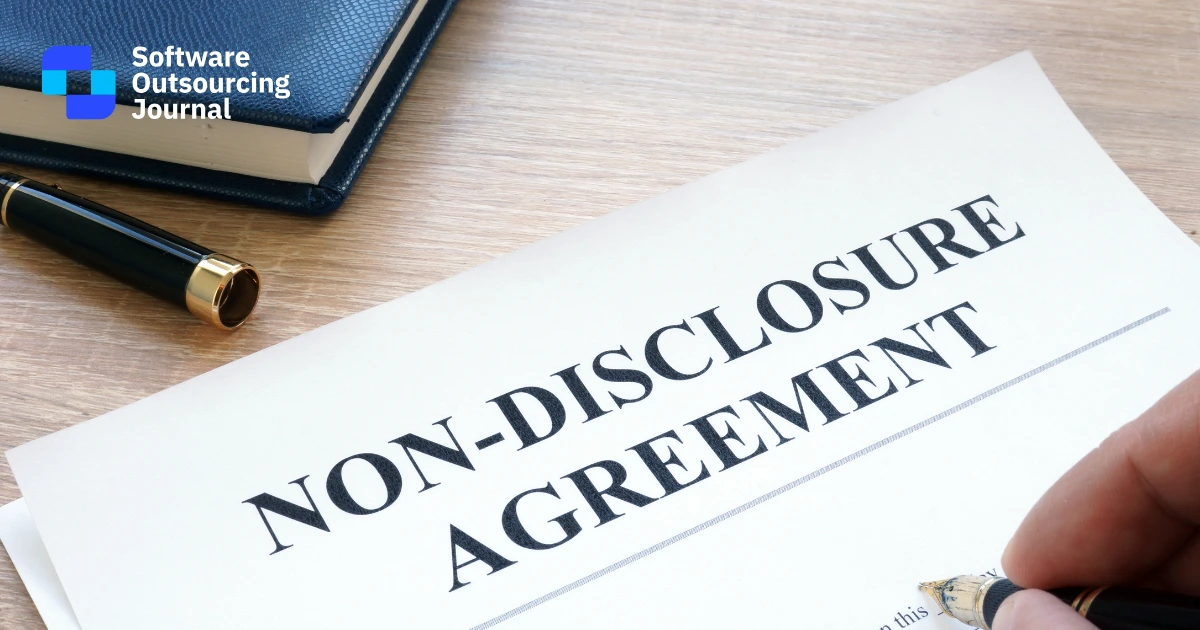
Before a vendor can estimate your project, they often need to see sensitive material such as a product roadmap, an architecture diagram, or part of your codebase. An NDA for software development sets clear rules for what the other team can see, how they can use it, and what happens if something leaks.
This guide covers the main NDA types, key clauses, cross-border enforceability, and a checklist to review before you sign. It offers general information only, so ask an attorney to review any agreement before you rely on it.
Key Takeaways
- Sign the NDA before you share anything non-public, including during discovery calls and code reviews.
- An NDA protects information. It doesn’t transfer ownership of code, so put ownership terms in your services agreement or an IP assignment.
- Choose a mutual NDA when both sides will share proprietary material, and a one-way NDA when only you disclose.
- Extend the agreement to subcontractors, individual developers, and generative AI tools.
- An NDA works best alongside real access controls, and enforceability varies by country, so pick governing law and dispute resolution on purpose.
What Is a Non-Disclosure Agreement (NDA)?
A non-disclosure agreement (NDA) is a legally binding contract in which one or both parties promise to keep specified information confidential and use it only for an agreed purpose. In technical projects, that information typically includes source code, system architecture, product plans, datasets, and customer details. You may also hear it called a confidentiality agreement.
An NDA rarely works alone. In a typical engagement, it sits next to three other documents:
- Master services agreement (MSA): governs the overall relationship, including payment, warranties, and liability.
- Statement of work (SOW): defines scope, deliverables, timelines, and fees for a specific project.
- IP assignment: transfers ownership of the finished work product to you.
The NDA protects information. It doesn’t decide who owns the code, which is why ownership language belongs in the MSA or a separate IP assignment.
Types of NDAs for Outsourced Software Projects
Not every NDA is built the same way. A software development non-disclosure agreement usually follows one of three structures, and the right pick depends on who is sharing what. Start with the simplest option that fits and add complexity only when you need it.
One-Way (Unilateral) NDA
In a one-way NDA, only one party discloses confidential information and the other agrees to protect it. This fits early vendor screening, when you share requirements and the vendor shares nothing proprietary. It’s quick to sign and easy to review.
Mutual NDA
A mutual NDA binds both sides. It’s the common choice once a vendor shares its own frameworks, internal tools, or pricing models, which happens in most outsourced projects. Mutual terms also tend to feel fairer, which can speed up negotiations.
Multi-Party NDA
A multi-party NDA covers three or more organizations under one set of terms. Consider it when a primary vendor, a security auditor, and an investor all need access to the same material. One agreement keeps obligations consistent, but make sure each party’s role is spelled out.
Which One Fits Your Project?
| Situation | NDA type | Why |
|---|---|---|
| You share requirements and code, and the vendor shares nothing proprietary | One-way | Simplest option, and it protects what you disclose |
| The vendor will share its own tools, frameworks, or pricing | Mutual | Both sides protect their proprietary material |
| Several vendors, auditors, or investors need access | Multi-party | One set of terms keeps obligations consistent |
| You’re screening vendors and sharing only high-level information | One-way | Light protection before deeper work begins |
Why You Need an NDA Before Outsourcing Your Software Project
With NDA outsourcing software projects, you’re handing over the things that make your business hard to copy. A signed NDA won’t stop every leak, but it sets expectations, creates legal recourse, and shows you took reasonable steps to protect what you built. Here’s where it does the most work.
Protect Source Code and Technical Assets
Think repositories, architecture diagrams, API keys, and proprietary algorithms. Say your startup gives a vendor read access to a private repo so they can estimate a rebuild. If that code later shows up in a competitor’s product, an NDA gives you a contract to enforce and evidence that the vendor knew the material was confidential.
Safeguard Product Roadmaps and Business Strategy
Feature plans, launch dates, pricing logic, and customer lists are often worth more than the code itself. A vendor that works with several clients in your market will see a lot of this information. The NDA keeps what they learn from your project out of someone else’s plans.
Protect Customer and Personal Data
An NDA is not a data processing agreement. If the vendor will touch personal or regulated data, you also need the right paperwork, such as a data processing agreement for GDPR, service provider terms for CCPA, or a business associate agreement under HIPAA. Treat the NDA as the confidentiality layer, not the compliance layer.
Strengthen Your Legal Position if Something Goes Wrong
US trade secret law, including the federal Defend Trade Secrets Act, generally expects owners to take reasonable measures to keep information secret. A signed NDA, paired with access controls, is strong evidence that you did. Without one, it’s harder to argue that shared information stayed secret in the first place. Have an attorney confirm how this applies in your state.
When Should You Sign an NDA With an Outsourcing Partner?
Sign before you share anything that isn’t public. Here’s a simple timeline:
- Initial research: Stick to public information. No NDA is needed yet.
- First discovery call: Sign before you discuss unreleased plans or requirements.
- RFP or proposal request: Sign before sending detailed requirements.
- Technical due diligence: Sign before any code or architecture review.
- Onboarding: Confirm every individual developer is covered before access is granted.
Before Discovery Calls and RFPs
Some information is safe to share without an NDA: your public website, a general description of the problem, and your budget range. Anything unreleased is not, including feature plans, pricing logic, customer names, data samples, and system architecture. If a vendor hesitates to sign before a first call, treat that as a signal about how they’ll handle your data later.
Before Technical Due Diligence or Code Review
Code audits expose the most sensitive material you have: source code, infrastructure details, and often security weaknesses. Require a signed NDA, limit access to the specific repositories under review, and set an end date for that access. If a third-party auditor is involved, make sure they’re bound too.
Key Clauses Every Outsourcing NDA Should Include
A strong NDA agreement for software development is specific. Vague language is the most common reason these contracts fail when tested. Use the clauses below as a review list when you read a draft, and note what to watch for in each.
Definition of Confidential Information
Define confidential information broadly enough to cover source code, designs, data, business plans, and verbal disclosures. Tie it to a reasonable standard, such as information that is marked confidential or that a reasonable person would understand to be confidential. Watch for definitions that only cover documents labeled “confidential,” since much of what’s shared in calls and chats never gets a label.
Permitted Use and Scope of Obligations
This clause limits use of your information to the project and nothing else. It should also require need-to-know access, meaning only people who actually need the material can see it. Watch for language that lets the vendor use your information to “improve its services,” which can quietly open the door to reuse.
Exclusions From Confidentiality
Standard exclusions cover information that is already public, already known to the recipient, independently developed, or lawfully received from a third party. These are normal. Watch for exclusions written so broadly that they swallow the rule, and make sure the vendor, not you, must show that an exclusion applies.
Term and Survival
Confidentiality obligations should outlast the project. Terms of two to five years after the relationship ends are common for general business information, while trade secrets should stay protected for as long as they remain secret. Watch for short, flat expiration dates that would free up source code or algorithms while they still have value. Confirm the right range with your counsel.
IP Ownership and Residuals
An NDA doesn’t assign ownership of code, so make sure the services agreement or a separate IP assignment does. Also watch for a residuals clause, which lets the recipient use information its staff remember without notes. For technical know-how, that can be a real loophole. If a vendor insists on one, narrow it or carve out source code and trade secrets.
Subcontractors and Personnel
Your NDA is only as strong as the people who can actually see your material. Require the vendor to pass the same obligations down to every employee, contractor, and subcontractor who gets access, and ask for a list of who they are. Individual sign-offs from developers add another layer of accountability.
Return or Destruction of Materials
When the project ends, the vendor should return or destroy your confidential information, including copies in repositories, backups, laptops, and chat tools. Ask for written confirmation. Watch for carve-outs that let the vendor keep archival copies indefinitely.
AI Tools and Generative AI Use
Many older templates say nothing about AI. Add language that limits how the vendor’s team can use public generative AI tools with your code or data, since pasting confidential material into a public chatbot can expose it. List any approved tools, and require that your information never be used to train third-party models.
Governing Law, Jurisdiction, and Remedies
Name the state or country whose law governs and where disputes will be resolved. Many buyers choose arbitration for cross-border deals, since a court judgment from one country isn’t always easy to enforce in another. Also include a clause for injunctive relief so you can ask a court to stop a leak quickly. If the NDA is with an individual contractor or consultant, ask your counsel about the federal whistleblower immunity notice that US trade secret law calls for in such agreements.
Is an NDA Enforceable When You Outsource Overseas?
Usually, but it depends on the terms and on where you would need to enforce them. A few practical points apply everywhere: use clear language, name the governing law, and decide up front how disputes will be resolved. Beyond that, each country has its own quirks. This section is general information and no substitute for local counsel.
United States
In the US, NDAs are governed mainly by state contract law, along with state and federal trade secret statutes. Courts generally enforce reasonable confidentiality terms, but state rules differ. California, for example, is strict about restrictions that work like a non-compete, so your NDA should protect information rather than limit where someone can work. Choose a governing law deliberately, and make sure your wording fits that state’s rules.
India
India is a top destination for engineering talent, so US buyers often ask how well NDAs hold up there. Indian courts generally enforce reasonable confidentiality obligations, but a few details matter. Most agreements are subject to state stamp duty, and an unstamped NDA can run into problems as evidence until the duty and any penalty are paid.
Indian law is also wary of restrictions on where people can work after a contract ends. Keep your NDA focused on protecting information, and avoid wording that could block developers from future jobs. For disputes, many US buyers choose international arbitration with Indian vendors. Have counsel who knows Indian law review the final draft.
Other Popular Destinations
Teams in Eastern Europe, Latin America, and Southeast Asia are popular choices, and the same rules of thumb apply. Confidentiality terms are broadly recognized, but procedures, formalities, and remedies vary. Work with local counsel in the vendor’s country, and consider international arbitration, since awards are generally easier to enforce across borders than court judgments under the New York Convention, which most countries have joined.
NDA Considerations for Startups, Private Equity, and Individual Developers
The basics stay the same, but who you are and who you hire changes what you should emphasize. Here’s how the priorities shift for three common situations.
Startups and Early-Stage Products
Founders often ask whether an NDA can protect an idea. Not exactly. An NDA protects confidential information you share, but it won’t protect a general concept once it’s public, or something the other side developed independently. What it does well is cover the details that give your idea its edge: designs, data, technical approach, and launch plans. Early-stage teams usually need a short, clear agreement rather than a twelve-page contract, and sharing less early on is the best protection of all.
Private Equity and Private Markets Portfolio Companies
When a private equity firm or one of its portfolio companies hires an outside development team, the confidential information often goes beyond code. It can include deal terms, fund performance, investor details, and portfolio financials. Private markets work is similar, since investor and fund data often sit alongside technical systems.
Make sure the definition of confidential information covers deal-related material. The NDA should also restrict sharing with other portfolio companies unless you allow it, and set clear rules for subcontractors. Have counsel check the terms against your fund’s own confidentiality obligations.
Freelancers and Individual Programmers
Freelancers sign in their own name, so make sure the individual developer is bound, even when you hire through a staffing platform. An NDA with a freelance programmer should cover the same ground as a vendor NDA, plus a written IP assignment, since code written by independent contractors doesn’t automatically belong to you. Employees are different: their confidentiality terms usually live inside the employment agreement, alongside invention assignment terms.
NDA Template for Outsourced Software Projects: What a Good One Looks Like
An NDA template saves hours of drafting when it fits your project. Whether it comes from a law firm, contract tool, or legal platform, the same questions apply.
What to Look for in a Template
Reading a sample NDA is a good way to learn the structure and typical wording. Samples written for individual engineers can also help when you bring on freelancers. Use each one as a reference and adapt it to your project before anyone signs. A good template should include:
- A definition of confidential information that explicitly covers source code, repositories, APIs, and technical documentation
- Language on AI tools and generative AI use
- Flow-down obligations for subcontractors and individual developers
- A clear term, with trade secrets treated separately
- A governing law and dispute resolution clause that matches your situation
Common Mistakes With Free NDA Templates
A quick search turns up plenty of free NDA templates, but free templates carry real risks:
- Too generic: They often skip technical definitions and leave gaps for code and data.
- Wrong jurisdiction: A non disclosure agreement India for software company teams drafted under Indian law won’t necessarily work under a US governing law.
- One-way when it should be mutual: Many templates assume only one party discloses.
- Missing modern clauses: Few address AI tools or subcontractor flow-down.
Format matters too. Most NDA templates come as a PDF, which is easy to read but hard to edit, or a Word doc, which is easy to customize but also easy to change by accident. A PDF works fine for review, but sign a clean, final version with all edits accepted. The best format is the one your counsel can edit and everyone can sign electronically. Some teams also use non-disclosure agreement software, meaning contract tools that handle templates, e-signature, and tracking, to manage NDAs at scale.
NDA Checklist Before You Sign
Run this checklist before you sign an NDA with any development partner. Each item is simple, but skipping one is how gaps appear.
Legal and Contractual Checks
- Correct legal names and authorized signers for all parties
- Clear definition of confidential information, including code and verbal disclosures
- Defined term and survival period, with trade secrets treated separately
- Governing law and dispute resolution chosen on purpose
- Remedies, including injunctive relief
- Ownership of the work covered in the services agreement or an IP assignment
Technical and Access Controls
An NDA only works if access is actually controlled. Pair the paper with these practical safeguards:
- Least-privilege access, limited to the repositories and systems each person needs
- Secure repositories, VPN or zero-trust access, and multi-factor authentication
- An approved tools list, including rules for AI tools
- Logging and review of who accessed what
- Offboarding steps: access revoked, devices wiped, and written confirmation of return or destruction
Vendor and Business Risk Checks
- References from similar clients
- Security practices and certifications, such as SOC 2 or ISO 27001
- Staff turnover and how the vendor onboards and offboards developers
- A full list of subcontractors
- Where the vendor is legally based and where your data will be stored
Red Flags in an Outsourcing NDA
Some warning signs show up before you ever sign. If you spot any of these, push back or walk away:
- A residuals clause that reaches source code or technical know-how
- No requirement to bind subcontractors and individual developers
- A vague definition of confidential information that leaves gaps
- No obligation to return or destroy your materials
- Exclusions or carve-outs so broad they swallow the rule
- A vendor who won’t say who will have access to your data
What to Do if a Vendor Breaches Your NDA
Even with a strong NDA, leaks happen. If you suspect a breach, move quickly and stay methodical:
- Preserve evidence. Save emails, logs, repository history, and anything showing what was shared and when.
- Cut access. Revoke credentials, repository permissions, and tool access right away.
- Send written notice. Notify the vendor in writing, following the notice terms in your agreement.
- Review your remedies. Check your contract for injunctive relief, indemnity, and dispute resolution steps.
- Call counsel. An attorney can advise on demand letters, injunctions, and next steps under your governing law.
Find a Reliable Development Partner on Software Outsourcing Journal
An NDA is one piece of a safe vendor relationship. The other piece is choosing a team you can trust in the first place. Browse more guides on Software Outsourcing Journal to vet providers, structure contracts, and protect your IP before you start.
FAQs
Is an NDA legally binding for outsourced projects?
Yes. When it’s properly drafted and signed by authorized parties, an NDA is a binding contract. Whether it’s enforceable in practice depends on its terms and where you would need to enforce it. Clear definitions, a reasonable duration, and a named governing law all help. Because rules vary by state and country, have an attorney review the agreement.
Can an NDA protect a software idea?
Only partly. An NDA protects confidential information you share, such as designs, data, and technical details. It generally won’t protect a general concept that’s already public, or something the other side developed independently. Share only what the vendor needs to see, and pair the NDA with clear ownership terms.
Should an outsourcing NDA be mutual or one-way?
Use a one-way NDA if only you will disclose confidential information. Choose a mutual NDA if the vendor will also share proprietary tools, methods, or pricing, which is common once a project gets underway. When in doubt, mutual terms are usually fairer and easier to negotiate.
How long should an outsourcing NDA last?
Two to five years after the relationship ends is a common range for general business information. Trade secrets, including source code and proprietary algorithms, should stay protected for as long as they remain secret. Talk to counsel about the right structure for your situation.
Does an NDA decide who owns the source code?
No. An NDA controls how information is shared and used, not who owns the finished work. Ownership of the code belongs in your services agreement or a separate IP assignment, which should state clearly that you own what the vendor builds for you.
Should an NDA mention AI tools?
Yes. Add language that limits how the vendor’s team can use public generative AI tools with your code or data, lists any approved tools, and prohibits using your information to train third-party models. Older templates often skip this, which leaves a gap.
Are free NDA templates safe to use?
They’re a reasonable starting point, but risky as-is. Free templates are often generic, may not fit your state or country, and rarely cover source code, subcontractors, or AI tools. Use one to learn the structure, then have an attorney adapt it to your project.
Do I need an NDA with each developer or just the vendor?
Ideally both. A vendor-level NDA binds the organization, and requiring the vendor to pass obligations down to every developer, plus individual sign-offs where possible, adds accountability. For freelancers, the individual must sign in their own name.
Final Thoughts: Protect Your Code Before You Share It
Protecting your code starts before the first kickoff call. Sign early, match the NDA type to who’s sharing what, and make sure the key clauses cover definitions, term, subcontractors, return of materials, and AI tools. Back the paper with real access controls, and choose governing law and dispute resolution you can actually enforce. A strong NDA won’t guarantee that nothing leaks, but it gives you clear expectations, evidence of reasonable care, and a path to act quickly if something goes wrong. Have an attorney review the final agreement, and treat this guide as general information rather than legal advice.