Managing a remote dedicated team already comes with time zones, tooling, and communication quirks. Add functional programming (FP) to the mix, and alignment becomes even more important (especially when not everyone’s used to thinking in maps and reduces).
But with the proper structure, mindset, and tools, remote FP teams can be some of the most productive and resilient units in software development. Here’s a practical guide to making that happen, based on real-world experience and a lot of trial and error.
1. Hire for Mindset, Not Just Syntax
You can teach Elixir. What’s harder to teach is the mental shift that comes with functional programming. That’s why the most successful hires aren’t always the ones with the most FP experience — they’re the ones who stay curious and open to revising old habits.
FP tends to reward developers who think in decomposable abstractions, breaking a problem down into small, pure functions that can be combined in various ways. You want people who are comfortable challenging assumptions, breaking things down into parts, and leaning into immutability for support and guidance, rather than suffering from it.
Look for candidates who:
- Reach for functional patterns even when using JavaScript, Python, or Ruby
- Can explain trade-offs clearly — not just what they did, but why
- Ask questions that show they’re thinking about the bigger picture
- Aren’t afraid to share unfinished work or ask for help
Practical tip: Skip the algorithm puzzles. Give them a task that mimics a real problem your team solved. Then evaluate how they think, how they document decisions, and how they communicate uncertainty.
2. Create a Culture of Learning and Ownership
You can’t fake your way through FP. It forces you to slow down and understand what you’re doing. Which is why teams thrive when learning isn’t just allowed, but expected.
Remote work can make it easier for people to struggle quietly. To counteract that, you need a culture where people feel safe asking questions, documenting their process, and owning both successes and mistakes.
What this looks like in practice:
- Internal show-and-tells. Even 15-minute demos of “here’s what I built and learned” go a long way
- Async decision logs. Don’t bury key architectural choices in Slack. Write them up and link them
- Lightweight RFCs. Before significant changes, post a proposal and gather input across time zones
- Clear code ownership. Everyone knows who’s owning what, but there’s no gatekeeping.
The goal isn’t to know everything. It’s to make it easy for everyone to learn anything.
3. Define Roles and Expectations Early
In a remote setup, ambiguity is the enemy. Mainly, when your team is spread across three continents and half the team doesn’t overlap in real-time. Roles and responsibilities need to be clear enough that people aren’t constantly blocked waiting for answers.
Rather than listing job titles, think in terms of collaborative responsibilities:
- One person keeps the system architecture consistent and helps others make trade-offs visible (your Tech Lead)
- Small dev groups (pairs or trios) own features end-to-end. They design, build, and test together
- A DevOps/SRE-type role ensures that environments support FP principles: immutability, reproducibility, and observability
- The Product Owner turns complexity into clarity, breaking down features into testable ideas and aligning priorities
- QA partners help define edge cases early and promote testing techniques like property-based tests
You don’t need a big org chart. You need shared awareness. People should know who to ask, what’s expected of them, and how decisions are made.
What to Avoid (Even If You Mean Well)
Putting together a remote FP team takes work, and there are a few common pitfalls teams often run into along the way.
- Hiring for jargon instead of judgment: It’s tempting to favor candidates who know all the FP buzzwords. But the best people solve real problems, not just recite theory.
- Underestimating onboarding effort: Bringing someone on board isn’t just about filling a seat. Without clear guidance and early wins, even skilled devs can get stuck, especially when they’re remote.
- Letting documentation gather dust: Decision logs and design docs only help if someone updates and references them regularly. Outdated context quietly trips people up.
- Overcomplicating first tasks: New hires should feel progress early on. If it takes weeks to get a simple change in, you risk losing momentum and confidence.
- Confusing async with absence: Remote doesn’t mean invisible. Teams need regular, thoughtful communication, not radio silence.
4. Make Mentorship and Pairing Part of the Workflow
FP can feel like learning to code all over again, even for senior developers. That’s why pairing and mentorship shouldn’t be “nice to haves.” They’re your fastest path to building shared language, avoiding silos, and leveling up junior and mid-level engineers.
The trick is to make it part of your regular cadence, not an extra meeting squeezed into someone’s Friday.
How to integrate it without creating Zoom fatigue:
- Schedule 2–3 short pairing blocks per week: one for code, one for architecture, one flexible
- Rotate mentors every 2–3 weeks for new hires, so they build relationships and context across the team
- Keep a running “what I learned this week” channel or Notion doc. Even small notes build collective knowledge
Don’t wait for people to struggle in silence; build support into the way work happens.
5. Choose Tools That Support Focus and Transparency
When your team is spread out, your tools basically are your office. They either support clarity and flow, or they slow everything down. When your tools do their job well, people spend less time checking in and more time building.
Here’s a solid toolkit to start with:
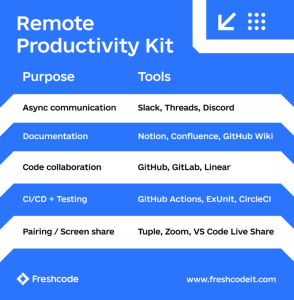
Best practices:
- Keep documentation version-controlled — even meeting notes and decisions. This is invaluable when original team members leave or when you need to revisit choices months later.
- Use Slack intentionally: set quiet hours, pin summaries, reduce “noise” channels.
- Use code review tools not just to catch bugs, but to model thinking — explain the “why,” not just the “what.”
6. Track the Right Metrics and Talk About Them
Think of metrics less as control and more as insight: they help highlight what’s going well, what might need support, and where team habits are shifting. For remote FP teams, the real value shows up in clear thinking, strong collaboration, and steady personal growth, and not just in output.
A few telling signals to track:
- Code quality: Are you seeing fewer regressions? Are reviews thoughtful and thorough?
- Engagement: Are people asking good questions in retros? Proposing small improvements?
- Learning culture: Are internal posts or learning notes being shared? Do people pair across roles?
- Delivery cadence: Are small, stable features shipping regularly? Or is work getting stuck in review?
Schedule regular time for feedback:
- Monthly retros with real talk about what’s working, what’s not
- Quick pulse surveys every 6–8 weeks (1–5 scale, open comments)
- Regular 1:1s with prompts around learning, blockers, and team dynamics
Think of feedback like CI for your team’s process. The earlier you catch issues, the easier they are to fix.
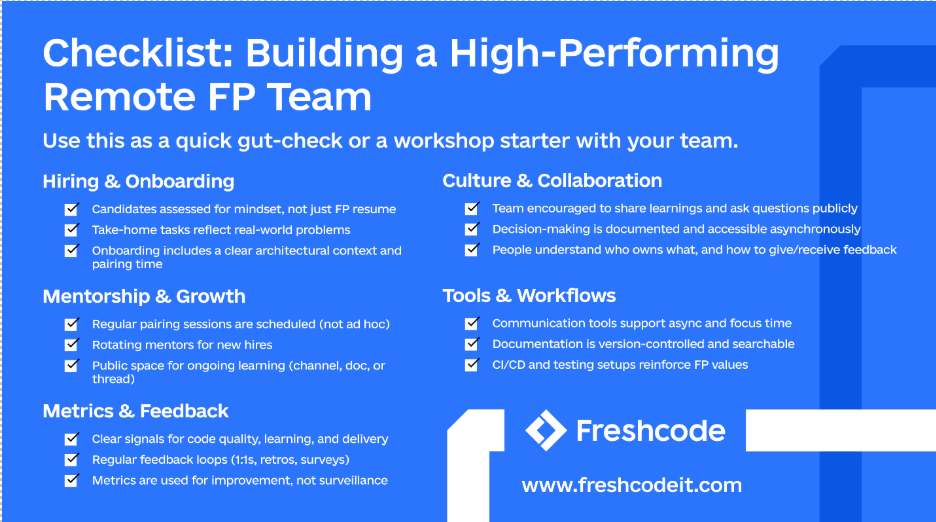
Takeaway
Great functional programming teams don’t happen by accident. They’re the result of intentional design, with clear responsibilities, room to grow, and a structure that supports both focus and creative problem-solving, even across time zones.
You won’t get everything right immediately, and that’s okay. Hiring thoughtful people, providing solid support, and encouraging ongoing conversations create an environment where the team improves naturally. Growth happens through everyday decisions and honest feedback with the right mindset, and over time, you’ll see your remote FP team find its rhythm and deliver real value.
Looking for more insights on building and scaling distributed engineering teams? Software Outsourcing Journal regularly covers practical guides, vendor evaluations, and team-building strategies for tech leaders navigating remote work.